

What’s Inside a Shoe?
Have you ever wondered what makes a shoe and what all the terms a manufacturer or cobbler use mean? I found this helpful terminology article that the blogger Old Shoe Leather put together as very helpful in understanding all that goes in making a pair of shoes.
Next time you receive a new pair of David Spencer or Buffalo Jackson shoes pull out this guide and take a walkthrough your new pair. A little knowledge goes a long way!
Terminology
- Arch:
- The padded area of the insole of a shoe, which is designed to support the arch of the foot.
- Back Seam:
- The vertical seam used to attach the quarters together at the center of the rear of a shoe.
- Back Stay:
- A short strip of leather that connects the quarters down the back of the shoe.
- Collar:
- A, sometimes padded, strip of material attached to the topline/opening of a shoe.
- Counter:
- A stiff piece of material usually made of leather, plastic, cardboard, or other stiff but plyable material that is inserted between the shoe lining and the upper located at the rear of the shoe, just above the heel.
The counter is used to strengthen the rear of the shoe and support the rear heel of the foot. It also helps retain the shape of the shoe. A Heel Counter can also refer to the exterior decoration on the back of a shoe (similar to a toe cap)
- Eyelets:
- Holes in the upper, above the tongue, where shoe laces are laces. Eyelets may be reinforced with a grommet for less wear on the shoe material. As a side note: The plastic tips on shoe strings are called Aglets.
- Facing:
- The part of the shoe where the shoelace eyelets are located.
- Foxing:
- A piece of leather trimming fitted into or on top of the rear quarters.
- Gore:
- An elastic panel attached to each side of the vamp to make a shoe more comfortable and easier to put on and take off. A Hidden Gore is covered by the tongue of a shoe and provides added comfort.
- Heel:
- The heel of a shoe, which raises the rear of the shoe, is considered part of the sole of a shoe although is is normally an independent piece of material. There are also names for the various areas of a heel:
- Heel Breast:The area of the heel that faces the front of a shoe, typically located below the rear arch area of the foot.
- Heel Seat:The area of the heel that is attached to the sole of a shoe.
- Heel Tip:Used to refer to the Top Piece of a narrow, high heeled shoe (such as a Stiletto). Heel Tips are usually made of plastic or rubber.
- Top Piece:The area of the heel that contacts the ground. When a shoe is manufactured the heel is attached to the shoe while the shoe is upsidedown, therefore the “bottom” of the heel, when a shoe is placed on a foot, is the “top” when it is being manufactured.
- Inseam:
- A hidden seam on a shoe attaching the welt, upper, lining and insole.
- Insole:
- The layer of material that lays on top of the sole inside a shoe, where the bottom of your foot contacts a shoe.
- Linings:
- A material, usually leather, sheepskin or cloth, that covers the inside of the upper to make a shoe more comfortable.
- Mid-sole:
- A layer of cushioned material between the innersole and outsole, adding additonal comfort and support to a shoe.
- Outsole:
- The part of the sole that touches the ground, usually made of leather or rubber.
- Plug:
- The sewn in vamp on a loafer. Usually defined as a plug if the material or texture is different than the rest of the shoe.
- Puff:
- Reinforcement inside the upper at the toe of a shoe to give it shape and support.
- Quarter:
- The back half of the upper. Attached at the front to the vamp, making up both sides of a shoe, and wrapping around the rear of the shoe. On some shoes the vamp and the quarter are a single piece of leather.
- Shank:
- A rigid material (usually metal or plastic) located between the insole and the sole of the shoe to supply support.
- Sole:
- The part of the shoe that sits below the wearers foot. The upper and sole make up the entire shoe.
- Throat:
- The area of the shoe where the top cap ends, or the area where the base of the tongue is attached to the vamp.
- Toe cap:
- A piece of material that covers the front upper of the shoe. Toe caps can have decorative patterns and shapes, to include wingtip.
- Tongue:
- A piece of material, usually leather or cloth, sewn into the vamp of a laced shoe, extending between the throat and the waist of a shoe.
- Topline:
- Also refered to as the Rim or the Collar, it is the top edge of the upper or opening of a shoe.
- Upper:
- The part of a shoe that covers the entire top, sides and back of the foot.
- Vamp:
- The part of upper that covers the front of the foot and attaches to the quarter.
- Waist:
- The area of a shoe between the in-step and arch.
- Welt:
- The piece of material, or process, used to join the upper to the sole. When the upper and the sole are stiched together, resulting in a visible stiched seam it is referred to as a Goodyear Welt or Norwegian Welt [two different processes] (as opposed to a Blake stitch which is not visible from the top of the shoe).



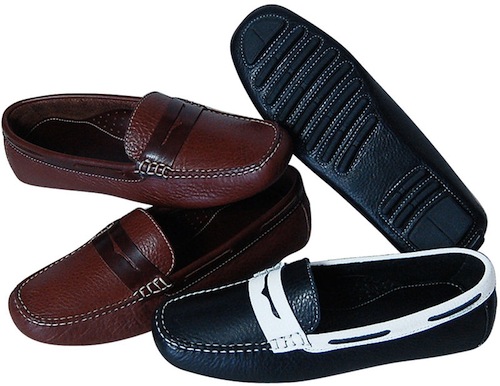
 David Spencer Casual Footwear